
AWS GenAI Overview of ML
Overview of ML
To understand generative AI, you need to understand ML.
You might ask yourself, "How do machines learn?" ML trains a computer to recognize patterns in historical data to make predictions on new data.
These predictions help you take actions. ML works as follows:
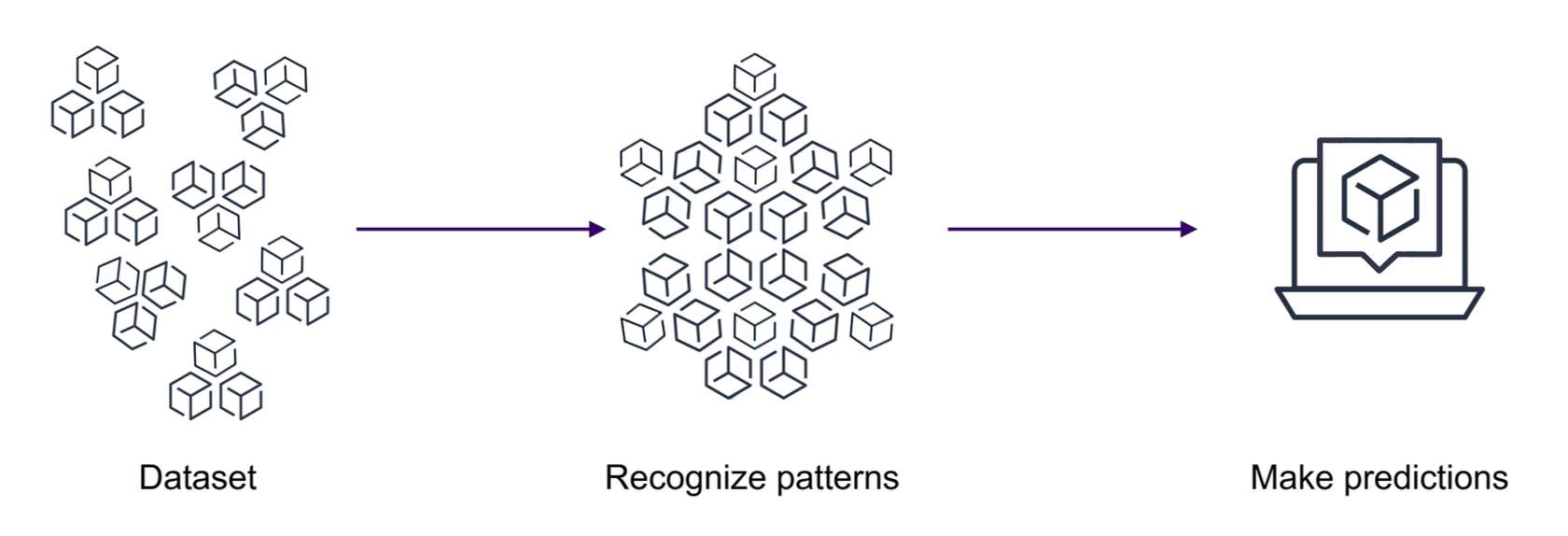
You use a dataset to train a model. In this dataset, there are features and labels.
The goal is to take the features as inputs and find a formula that predicts the labels, or outputs.
The resulting ML algorithms can take new data, recognize patterns in the data, apply the formula, and make predictions about the data.
ML trains a computer to recognize patterns in historical data to make predictions on new data.
The difference between generative AI and traditional ML
Generative AI is a subset of deep learning that can adapt models built using deep learning, but without retraining or fine-tuning.
Deep learning uses the concept of neurons and synapses similar to how your brain works.
An example of a deep learning application is Amazon Rekognition, which can analyze millions of images, streaming and stored videos within seconds.
Amazon Q Developer, an example of a generative AI application, can generate code suggestions in real time based on your comments and existing code.
How it works
Generative AI is powered by large language models that are pretrained on internet-scale data, and these models are called foundation models (FMs).
With FMs, instead of gathering labeled data for each model and training multiple models as in traditional ML, customers can adapt the same FM to perform multiple tasks.
The large language models (LLM) have the ability to predict the next word in a sentence by taking into consideration the position and the context of a word in a sentence.
LLMs use this ability to generate new content
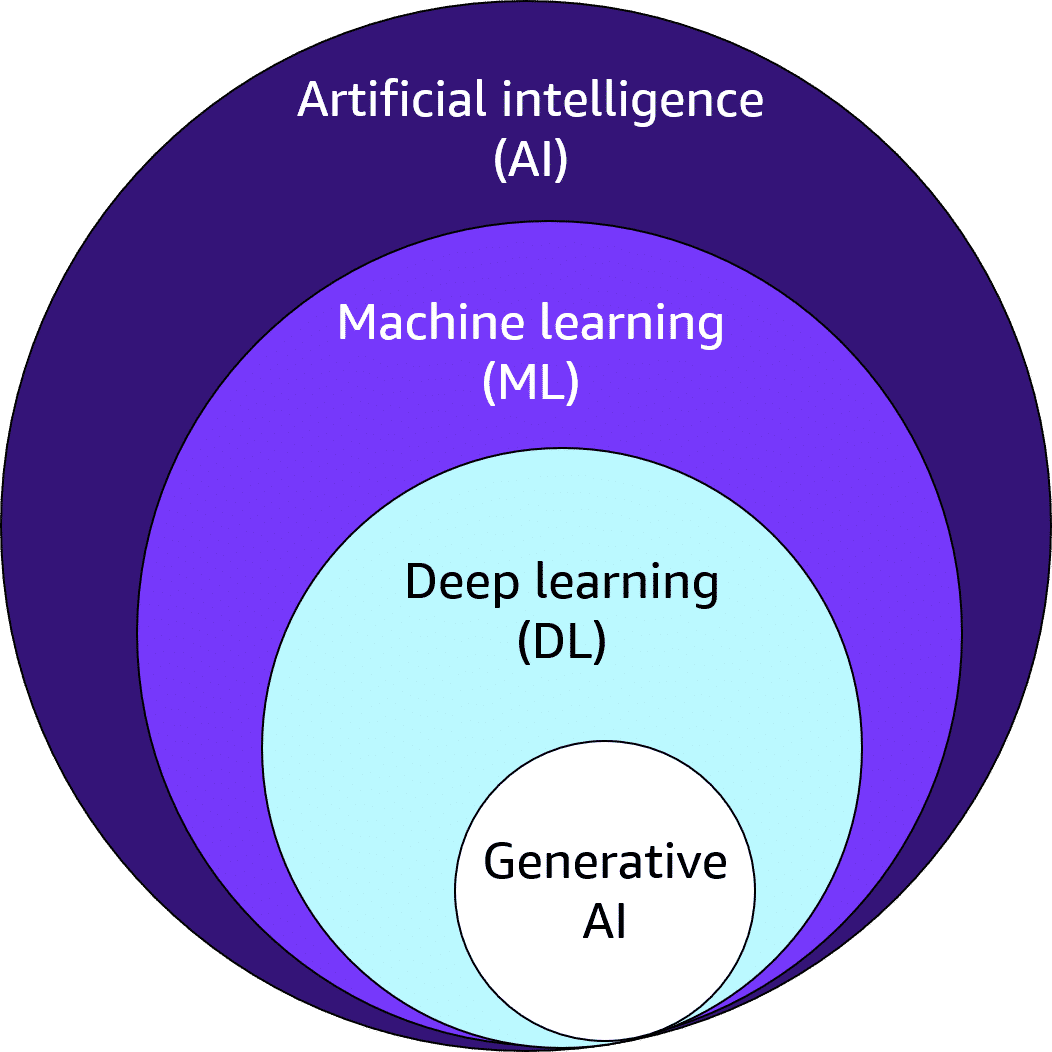
Image created by Amazon Web Services.
Generative AI is a subset of deep learning that can adapt models built using deep learning without retraining or fine-tuning.
Evolution of ML
Machine learning has been around for decades and the data scientists have been building language models for many years.
What has led to the emergence of generative AI right now?
- Investment in team sizes
- Wilingness in big ideas
- Investment in compute
You can attribute the emergence of generative AI at the present moment to huge investments in resources.
Hiring a large team, spending on compute resources, and having the willingness to invest and develop big ideas all contribute to the current rise of generative AI.